

In Mila's Footsteps, 1919 – 1942
%2C%20and%20Sacha%20Racine%2C%20Paris%2C%20circa%201927.jpg)
Photo: Mila, Emmanuel (Mola), and Sacha Racine, Paris, circa 1927. Photo courtesy of the Racine family.
Mila’s Childhood and Adolescence
She was born on September 14, 1919, in Moscow and, although her given name was Myriam, she was always known as Mila. When I interviewed several of her cousins, many years ago, they told me they often used a particular form of endearment that, when spoken, sounded like “Mil-ush-ka.”
In 1926, the Racine family emigrated to Paris. At the time of the move, Mila was seven years old; her brother, Emmanuel (known as Mola), was fifteen, and her sister, Sacha, was three.
Soon after settling in Paris, the family lived in an apartment building located at number 97, rue de Rome, in the Seventeenth Arrondissement of Paris, north and west of the Gare Saint-Lazare.
In March 2016, the City of Paris held a ceremony to inaugurate a commemorative plaque placed on the front façade of that building. The plaque reads as follows:
To the Memory of MILA RACINE, 1919 – 1945, Croix de Guerre and Médaille de la Résistance, killed in deportation, at Mauthausen, saved the lives of 236 Jewish children, lived in this building from 1926 to 1940, with her brother Emmanuel and sister Sacha, also resistors.
Note: As I explain in The Fate of Others, the 24 convoys that the MJS passed across the border in 1943 were comprised of a total of 274 people. Of that number, the great majority -- 239 -- were unaccompanied children.

Photo: Plaque installed at 97, rue de Rome, 75017, Paris, March 2016.

Photo: Ceremony to Inaugurate Plaque at 97, rue de Rome, March 2016. © Nancy Lefenfeld.
The ceremony held in 2016 was attended by many – officials of the City of Paris, men and women whom Mila had helped smuggle across the border in 1943, descendants of those whom she helped, members of the extended Racine family, and others. The woman shown here is Frida Wattenberg, who was also a member of the MJS (Mouvement de la jeunesse sioniste) and carried out various types of humanitarian resistance activities, such as chaperoning Jewish children from Grenoble to Annemasse, so that they could be passed across the border.
Growing up in Paris, Mila had a happy childhood. Many members of the extended Racine family – aunts, uncles, and cousins – had also emigrated from Moscow to Paris. To celebrate Jewish holidays and other occasions, they would gather around a tremendous dining room table in the Racine apartment on the rue de Rome. Berthe – described as strong-willed, outspoken, and opinionated – would make sure that everyone ate well. Then she would play the piano, and the whole clan would sing songs in Russian, Yiddish, Hebrew, French, Italian, and Ladino (Judeo-Spanish).
Mila shared her mother’s passion for music. Those who knew her, however, told me that, in terms of physical
build and temperament, Mila resembled her father more than her mother. Tall and thin, gentle and mild-mannered, Hirsch was a man who loved the quiet of Shabbat. In the early 1920s, before emigrating to Paris, he had visited Palestine. He told his children stories about that visit. His stories – and his dream – deeply influenced his children.
Mila was a good student and excelled in her English language courses. In 1936, she graduated from the Lycée Racine (named after the 17th century French dramatist, Jean Racine). She spent some time in London, studying English at the City of London College on Ropemaker Street.
A Young Adult Under the Occupation
In June 1940, as the German army approached Paris from the north and east, approximately two million of the city’s residents fled south. Mila’s immediate family and other members of the large Racine clan were among those who took flight. They settled in Toulouse, a city located in what was called the “Zone nonoccupée” (the Unoccupied Zone) or the “Zone libre” (Free Zone). Toulouse was overflowing with people who had left their homes in other parts of France as well as in Belgium, the Netherlands, and elsewhere.
Like many other young women and men, the 21-year old Mila found herself completely uprooted from what had been her normal life. Two cousins of Mila’s whom I interviewed in the year 2000 spoke at length how important Mila had been to them in Toulouse in the summer and fall of 1940. The cousins, who were then nine and seven, had lost their father to tuberculosis the previous year. Their grief-stricken mother was scarcely able to function. Each day, Mila cared for the girls, taking them on long walks, telling them stories and teaching them English. She had, they told me, an “insight into people.” She was a calm and loving presence at a turbulent time and had had a great influence on their lives.
By chance, not design, the Racine home was the setting for some of the earliest debates about the possibility of Jewish resistance in France. Mola (Mila’s brother) would write the following after the war:

Photo: Mila Racine with niece Lili Racine, date unknown (likely mid-1930s). Source: Mémorial de la Shoah, MI_1188..
Mola is referring to David Knout and Ariane Knout-Fixman, a dynamic and outspoken couple originally from Russia. In the summer of 1940, the Knouts and others would meet at the Racine home. These meetings led to the formation of a committee called “Main forte” (meaning “Strong Hand"). Strong Hand was the predecessor organization to the Armée juive or “AJ” (Jewish Army).
Also of great significance was the fact that, in the fall of 1940, Mila attended an intensive two-week leadership training camp held by the Éclaireurs Israelites de France (the Jewish Scouts) at a location fifty miles north of Toulouse. The camp was organized and led by a dynamic young man named Simon Lévitte. The extremely disciplined Lévitte urged the attendees, whom he saw as the young leaders of Jewish youth in France, to consider the challenges that lay before them and to prepare themselves physically, mentally, and spiritually.

Photo: Ariane Knout, Location and date unknown. Source: Mémorial de la Shoah, MXXXIIIa_22.
We can see with the benefit of hindsight that the ten months spent in Toulouse had a profound impact upon Mila, setting her upon a path that she would follow from that time on.
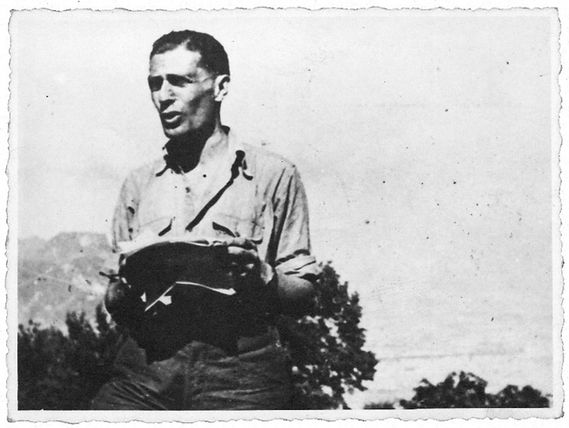
Photo: Simon Lévitte, location unknown, circa 1940. Source: Mémorial de la Shoah, ARJF_MIX_35.

Photo: Buildings housing the thermal baths in Luchon, 2010. © Nancy Lefenfeld.

Photo: House located in Luchon, 2010. © Nancy Lefenfeld.
In April 1941, at the order of departmental authorities, Mila’s family moved to Bagnères-de-Luchon, a small spa town in the foothills of the Pyrenees mountains long known for its sulfurous, hyperthermal waters. The Racine family would live in the town until late 1942.
The very large internment camp of Gurs was located in this same part of France, about 100 miles northwest of Luchon and just outside the town of Oloron-Sainte-Marie. Mila and Sacha were aware that people in the camp were dying due to its poor living conditions, including a lack of adequate food. Mila conceived of a project to help feed those in Gurs. She and Sacha solicited monetary donations from families in Luchon and used the money to purchase certain types of items, such as beans, on the black market. Further, because poor storage conditions in the camp had resulted in food spoilage, the sisters, helped by others, devised a method of canning the items prior to sending them to Gurs. (As I mention in my book, I learned of this humanitarian project from Sacha, when I interviewed her in 2000.)
When I visited Bagnères-de-Luchon in 2010, I felt it was easy to imagine what the town looked like in 1941, when Mila and her family lived there. Here are some of the photos that I took at that time, showing buildings in the town of Luchon as well as in the adjacent commune of Saint-Mamet. (Saint-Mamet is nestled between Bagnères-de-Luchon and the Spanish border.)

Photo: The Hôtel des Pyrénées, located in Luchon, on the allées d’Étigny and the rue Victor Hugo, 2010. Mila and her family lived in this hotel during their stay in Luchon. © Nancy Lefenfeld.

Photo: House located in Saint-Mamet. © Nancy Lefenfeld.

Photo: House located in Saint-Mamet. © Nancy Lefenfeld.
An MJS Leader in Nice and Saint-Gervais
From November 1942 until September 1943, members of the Italian Fourth Army occupied the southeast part of France. What happened in southeast France during this time – and the impact it had on Jewish survival – remains a relatively unknown chapter of history of the Shoah in France. If you wish to delve into the history of this period, please see the page of this site entitled "Italian Occupation" (or click on this link.)
German officials fully expected that their military ally, Italy, would arrest Jews living under their jurisdiction and turn them over to French or German authorities, to be deported. To their surprise, dismay, and anger, this did not happen. The Italian government instructed its military forces not to carry out any actions that would threaten or harm Jews. Word quickly spread among Jews living in various parts of France that the Italian Occupation Zone was a safe haven. Despite the difficulties and risks associated with travel, many Jews managed to make their way to the zone. Nice was the largest city located within the Italian Occupation Zone. Many of those seeking to place themselves under the jurisdiction of the Italian army relocated to Nice.
Photo: MJS gdoud (brigade), Saint-Gervais-les-Bains, summer 1943. Mila appears in the center of the third row, wearing a dark blouse, open at the collar. © Mémorial de la Shoah, MXXXIIIa_46.
In the early months of 1943, German officials grew increasingly frustrated with the situation regarding Jews in the Italian Occupation Zone. In their attempt to pressure the Italians to take action, they made many false claims against Jews. Included among these was that their presence in Nice, on the Mediterranean coast, posed a security threat.
To placate their more powerful ally, in late March Italian authorities embarked on a program of relocating a few thousand Jews out of Nice, to remote towns and villages within their occupation zone. Jewish leaders in Nice assisted the Italians in this effort, and the relocation was voluntary, not compulsory.
Two towns in the department of the Haute-Savoie – Saint-Gervais and Megève – received the largest numbers of persons who were transferred. Mila volunteered to relocate to Saint-Gervais, to assist in the resettlement and to organize a new MJS gdoud in Saint-Gervais.

Photo: Jacques and Léa Wajntrob, Nice, 1943. Photo courtesy of the Wajntrob family.
In late 1942, the Racine family left Luchon and moved to Nice. There, Mila and Sacha joined the local group of what was called the “MJS” – the Mouvement de jeunesse sioniste or Zionist Youth Movement. The MJS gdoud (Hebrew for “brigade”) in Nice was led by a dynamic young couple named Jacques and Léa Wajntrob. MJS members worked alongside other Jewish organizations that were helping to support and care for the new arrivals. Mila became a key assistant to Jacques and Léa.

Photo: Several of Mila’s friends in Saint-Gervais in the summer of 1943. Left to right: Hélène Gorgiel-Sercarz, Marie Grünberg, Marianne Hartann, Alex Derczanski, Sarah Grünberg, and Maurice Grunberg.
© Mémorial de la Shoah, MXII_5935.

MILA'S LEGACY
Sarah Grunberg (shown in the above photo) was a member of the MJS gdoud in Nice and in Saint-Gervais. In Saint-Gervais, Sarah -- along with Mila, Sacha and other young adults -- lived in the Hotel Val Joly.
In 2004, I spoke with Sarah over the phone. She kindly answered questions I had and shared her recollections. Following the conversation, she wrote me a letter in which she stated what she called the “principal elements of her memories” regarding Mila. Here are a couple of excerpts from that letter.
I met Mila for the first time in Nice, in the meeting room of the MJS group, at the beginning of 1943. What struck me right away was her charm, her beauty, an aristocratic grace that emanated from her.
J’ai rencontré Mila pour la première fois a Nice dans le local de réunion du groupe MJS vers le début 1943. Ce qui m’a frappé en premier lieu, son charme, sa beauté, une grâce aristocratique, qui émanait de sa personne.
Mila and her sister Sacha had a room in same house, on the fourth floor. Regarding her involvement in the group, what I remember most are her speeches; she possessed a real gift for oratory, igniting her audience. Communicating to everyone hope and courage, she was greatly admired and loved by all.
Mila et sa sœur Sacha occupait une chambre dans la même maison au 4eme étage. De son action au sein du groupe, ce qui me reste surtout en mémoire, ce sont ses discours elle possédait un réel don d’orateur enflammant son auditoire. Communiquant a tous espoir et courage, elle était très admirée et aimée de tous.

One of several of artworks depicting Mila created by her niece, Daniella Wexler Racine.