

The Call to Resist Nazi Oppression
Overview of Smuggling Operations at the Border
In March 1943, the child rescue group known as “OSE” – which stands for Œuvre de secours aux enfants, generally translated as Children’s Rescue Network – had begun smuggling groups of unaccompanied children from France and into Switzerland. The border crossings were staged in the French department of the Haute-Savoie. The children were passed into the Swiss canton of Geneva. Once having crossed the border, the children were safe; they were beyond the reach of German and French authorities.
You may be wondering: Why didn’t the parents cross the border with their children? Why only the children? Jewish refugees were not welcomed into Switzerland and had no right to asylum. Moreover, up until the end of 1942, policies and practices regarding what would be done to Jews who entered the country illegally varied from canton to canton and from one period of time to the next. Jews who managed to cross the border might be turned back or they might be allowed to stay. If turned back, they might be directly handed over to French authorities and subject to arrest and deportation. The situation changed, however, in late 1942. The Swiss Federal government defined a number of so-called “hardship cases” – that is, categories of people who would be allowed to remain in the country even if they had entered illegally. Among the categories of hardship cases were unaccompanied children less than 16 years old and families with a child younger than six. (Later, in July, the age limit for unaccompanied girls was raised to 18.)

Drawing: Crossing the border, from France into Switzerland, in the fall of 1943 or spring of 1944 was not an easy matter. The border was fortified with multiple rows of barbed wire and patrolled by German soldiers. This is a drawing, made by Evelyne Flam (née Zysman) in 1990, depicting her recollection of what the border looked like when she made the crossing in the spring of 1944. Evelyne was a part of a convoy organized and passed into Switzerland by members of the Bund.

Photo: A frame that appears in the 2002 film entitled Mémoires de la frontière (Memories of the Border). For the purposes of making the film, the barbed wire barrier that existed in 1943-44 was reconstructed based on archival photos. Note that Evelyne Flam's recollection drawing closely mirrors the photo.
In May 1943, OSE suspended its smuggling operations. There was no need to continue passing children across the border; Jewish children were safe once brought into the Italian Occupation Zone. However, at the end of July 1943, after Mussolini was deposed, the situation in the Italian Occupation Zone became destabilized and its future was uncertain. No one knew if or when Italian soldiers would withdraw from their zone in southeast France. Facing this uncertainty, in August, OSE resumed its smuggling operation. OSE officials also asked the MJS to organize a second smuggling réseau (i.e., network) that would operate separately from the first. Simon Lévitte asked Mila Racine to conduct a kind of “test case,” and, on August 17, she succeeded in getting a group of 11 unaccompanied children into Switzerland at a point just outside of Annemasse. The eleven children had all been living with their families in Saint-Gervais.
The Operation of the MJS Smuggling Network
Following the success of that initial “test case,” Simon Lévitte sent Tony Gryn, also a member of the MJS, to Saint-Gervais, to work alongside Mila. The 22-year old Tony was tall, slim, and handsome. Like Mila, he had been born outside of France – in his case, Lublin, Poland – but he had grown up in Paris and he spoke French fluently. Nothing about him drew attention to the fact that he was a foreigner and a Jew.
In a very short period of time – the last two weeks of August and first week of September – Mila and Tony took on what seems in retrospect to have been a Herculean effort. They recruited three others to join them in this effort: Maurice Maidenberg, Bella Wendling, and Sacha Racine (Mila’s sister). (Later, a young man named Roland Epstein would join the team as well.) By the end of the first week in September, the team had assembled and passed into Switzerland five more groups of unaccompanied children. During this time, they also left Saint-Gervais and set up a new base of operations in Annecy.
On September 8, 1943, General Dwight Eisenhower announced to the world that the Allies had signed an armistice with Italy. Immediately, Italian soldiers stationed in southeast France abandoned their positions and set off, by truck and on foot, towards the Italian border. The German army quickly seized the territory that the Italians had held for the previous ten months. The Gestapo set up a well-manned

Photo: Nethenal (Tony), Paris, 1946. Photo courtesy of the Gryn family.
headquarters in Nice and unleashed a reign of terror against all Jews living in the area. Historians would later agree that the methods used by the Nazis in the former Italian Occupation Zone to hunt down, seize, and deport Jews were particularly brutal and indiscriminate. Up until that time, although the Nazis had used such brutal and indiscriminate methods in some Central and Eastern European cities, they had, for the most part, refrained from using them in France and other Western European countries.
Around the same time that the MJS established a base of operations in Annecy, the German army set up a regional headquarters in that same town. In the ensuing weeks, the MJS team would conduct their work directly under the noses of German authorities.
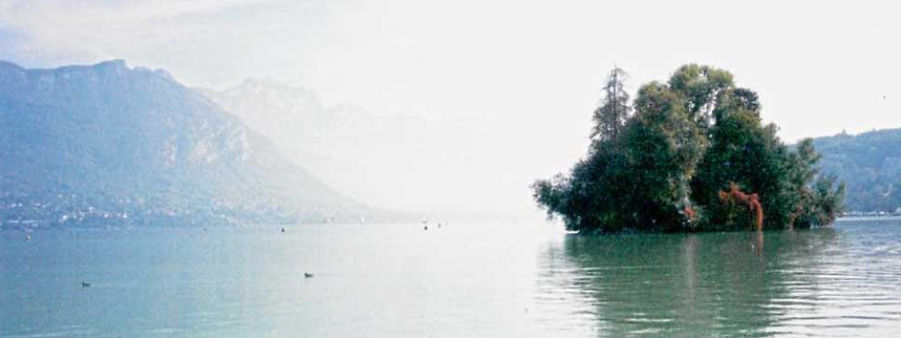
Photo: Lac d’Annecy (Annecy Lake), 2006. © Nancy Lefenfeld. Annecy is an ancient, dreamlike city in the French Alps. Annecy Lake is the third largest lake in France – 14 km long by 3 km wide (9 miles by 2 miles) and with a maximum depth of 82 meters or 270 feet. The lake was formed about 18,000 years ago, when alpine glaciers melted. Archaeologists date human settlement on its shores to 4000 BCE.
You might be asking yourself, Why would the MJS team conduct their operations from a base in Annecy? The MJS team was receiving Jewish children sent to them from other parts of France (Nice, Paris, Limoges, etc.). Typically, the children made the journey via passenger train. Annecy was the logical point of reception because, in terms of rail service, it was the most accessible town in the department of the Haute-Savoie. (Reaching the department of the Haute-Savoie was, for many, the key steppingstone to reaching the French-Swiss border.)
Who was sending the children to the MJS team? Several Jewish organizations were working illegally and clandestinely to transfer Jewish children from distant places in France to the MJS team in Annecy. These humanitarian resistance groups included OSE, the Sixième (the underground arm of the Éclaireurs Israélites de France, known as the Jewish Scouts), and the Rue Amelot Committee, to name a few. Typically, members of such groups would make the arrangements for a child or group of children to travel by train to Annecy. In some but not all cases, the child or children would be accompanied by an adult chaperone.)
Upon arriving in Annecy, children would be escorted to a safe house, where they would be fed and cared for. There they would wait for a short period of time – typically one to three days – as preparations were made to organize a “convoy” – that is, a group to be taken to, and passed across the border, into Switzerland.
Accompanying groups of children from Annecy to locations along the border and effectuating their crossing out of France and into Switzerland was an especially difficult and dangerous type of work. It entailed avoiding German patrols, crossing streambeds, and cutting through rows of barbed wire. All this had to be done while keeping the children quiet and calm. The adult organizers as well as most of their young charges understood that, if they were caught, they would be arrested and likely deported.
For the members of the MJS team, sustaining the smuggling operation was physically and emotionally exhausting. Yet, they kept up a sustained and rapid pace, passing an average of three groups of children from France into Switzerland per week.
The 274 Children and Adults Who Made the Crossing
The smuggling of Jewish children from France into Switzerland in 1943-44 was a form of humanitarian resistance. The term “humanitarian resistance” refers to illegal activities carried out clandestinely, to thwart an oppressor, to save human lives. Humanitarian resistance differs from what is traditionally referred to as “relief work.” Relief work encompasses legal activities carried out above ground to help those in need.
I believe that, in order to better understand how individuals helped one another to survive during the time of the Nazi regime, it is important to distinguish between humanitarian resistance and relief work.
What is an example of relief work carried out in France during the time of the Occupation? Organizations – both Jewish and non-Jewish – set up operations in some of the French internment camps for the purpose of helping internees. They worked to provide much-needed food and medical care and to organize activities for children. While this work was difficult and critically important, it was not inherently dangerous to those who carried it out.
Smuggling Jewish children from France into Switzerland was one form of humanitarian resistance. Another form of humanitarian resistance was the fabrication and distribution of good quality false papers (identity cards, baptismal certificates, and the like). For a Jewish adult living in France under the Occupation, having a good quality false identity card – whereby he or she might pass as Aryan – could mean the difference between life and death.
Humanitarian resistance was, by definition, dangerous. A person who engaged in humanitarian resistance put her or his life on the line. That is, she or he ran the risk of arrest, imprisonment, deportation, and death. The relatively high survival rate of Jews in France (76%) is intricately tied to the fact that Jews and non-Jews alike carried out small and large acts of humanitarian resistance. (The 76% survival rate refers to the proportion of Jews living in France on the eve of the Second World War who managed to survive the conflict.)
Because of the inherent danger, those who carried humanitarian resistance activities did so in great secrecy. They used aliases. They kept written records to a bare minimum. When it was necessary to record information, they often did so in a coded manner. Within a network of resistors, the dissemination of information was done on a strict “need to know” basis.
It is partly due to the need for secrecy that survivors, descendants of survivors, and researchers often find it difficult to understand and document, with precision, the nature and extent of such resistance activities.
In my book, The Fate of Others: Rescuing Jewish Children on the French-Swiss Border, I provide documentation on each of the 24 convoys of children that the MJS team smuggled from France into Switzerland in the summer and fall of 1943. I also document the names of the individuals comprising each convoy and provide key data pertaining to each one. When speaking of humanitarian resistance efforts, this level of detail is rarely possible. How is it possible in this case?
In 1943, when an unaccompanied child managed to cross into Switzerland illegally, he or she was placed under arrest by a Swiss border guard. The guard would prepare an arrest report. Here, I have reproduced the arrest report prepared for Wolf Wapniarz. Wolf was one of 19 children smuggled into Switzerland by the MJS team on September 24.
Within a few days following the arrest, a Swiss official would prepare a document called a “Declaration” for each child who had entered. The Declaration set forth pieces of information about the child as well as comments about how and/or why he or she had crossed the border. Although the child did not write the document, he or she was asked to sign the document. Here is the Declaration prepared for Wolf.
For nearly fifty years after the end of the war, these documents remained in storage in the archives of Geneva, little-used and largely unknown. They came to light in the 1990s.
I was fortunate to have the opportunity to consult hundreds of these arrest reports and Declarations. Along with archival information preserved in the Mémorial de la Shoah in Paris, these Swiss documents enabled me to reconstruct the MJS convoys passed into Switzerland in the late summer and fall of 1943 and to identify the individuals who comprised each of those groups.


Reproduction of two reports -- an arrest report (top) and Declaration (b0ttom) - prepared for Wolf Wapniarz by Swiss officials following his arrest in 1943. Each person who crossed into Switzerland and who was then permitted to remain in the country was given a unique numerical identifier -- in Wolf's case, 4911. Source: Archives d"État de Geneve .

This is a photo that Wolf Wapniarz took of himself and sent to me in 2017. In 1943, Wolf’s parents as well as his three brothers and one sister were all deported to Auschwitz. Wolf was the only member of his family to survive the Occupation. © Nancy Lefenfeld.

Painting of Mila by Daniella Wexler Racine.
MILA'S LEGACY
André Panczer was eight years old when he was smuggled across the border, on September 21, 1943. In his memoir, Je suis né dans l’Faubourg St. D’Nis, André describes how his parents sent him, by train, from Nice to Annecy. There, the MJS team hid him and cared for him along with others. After a few days, André and 18 others were taken to a café located on the outskirts of Annemasse. They hid in the rear room of the café throughout the day. When darkness fell, they were led out of the café. After walking a long distance, they reached the bank of the Foron river and crossed into Switzerland. André recalls the experience as having been terrifying. He wrote in his memoir that the children were “gripped by fear and anguish.” At the time, he did not know the identity of those who had organized or effectuated the crossing. In 2008, I sent André a letter, asking him if he was the child named André Panczer who had crossed the border, from France into Switzerland, in 1943. (I had seen, in the Geneva archives, the arrest report and Declaration that had been prepared for him, decades earlier, by Swiss officials.) It was at that time that he began a quest to learn more about Mila and the other members of the MJS team. In the nearly two decades that have elapsed since then, André and his wife, Rachel, have worked tirelessly to share the story of Mila’s life, work, and tragic death with hundreds of students and many others, both in France and in other countries. They have also been instrumental in initiating and overseeing the inauguration of commemorative plaques honoring Mila in various locations in the city of Paris and in Annemasse.